
Understanding PPA structures in India: group captive, third-party open access, and rooftop captive explained
India's renewable energy procurement landscape offers three distinct contractual pathways, each with different risk profiles, regulatory constraints, and financial outcomes. Here's how to choose.
On this page · 8 sections
What is a Power Purchase Agreement?#
A Power Purchase Agreement (PPA) is a long-term contract between a renewable energy generator and an off-taker (buyer), specifying the price, volume, delivery point, and duration of electricity supply. In India, PPAs are the primary instrument through which C&I consumers access renewable energy outside the grid tariff regime.
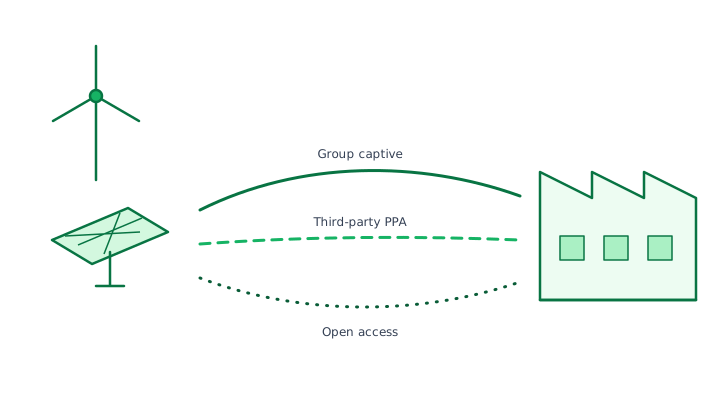
The Indian market currently supports three distinct PPA structures for C&I consumers: group captive, third-party open access, and rooftop captive. Each pathway sits within a different regulatory framework, carries different financial risks, and suits different load profiles.
Group Captive Structure#
How SPVs Work
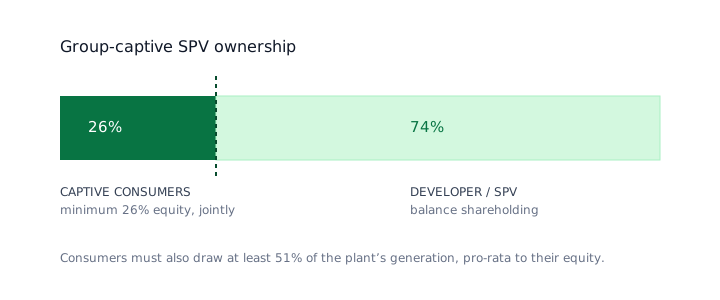
Under the Electricity Act, 2003 and Rule 3 of the Electricity Rules, 2005, a "captive generating plant" qualifies for key exemptions, including relief from Open Access charges and cross-subsidy surcharges, provided the off-taker holds at least 26% equity in the generating SPV and consumes at least 51% of the plant's output.
In a group captive arrangement, multiple C&I consumers jointly invest in a Special Purpose Vehicle (SPV) that owns and operates the renewable energy plant. Each consumer holds equity proportional to their contracted share of generation. The SPV sells power to its equity holders, which are treated as captive consumers under the law.
The 26% Equity Rule#
The 26% minimum equity requirement is non-negotiable. State Electricity Regulatory Commission (SERC) audits have disqualified projects where equity was held through nominee arrangements or where the off-taker's balance sheet could not substantiate the investment. Lenders and developers have developed standardised SPV structures, but consumers must maintain their equity holding for the duration of the PPA — typically 25 years.
Advantages#
Group captive is the most tariff-advantaged structure in most Indian states. By satisfying captive status, off-takers avoid:
- Cross-Subsidy Surcharge (CSS), which ranges from $6–$30/MWh depending on state and voltage level
- Additional Surcharge on open access transactions
- State transmission charges in some states where captive exemptions apply
The effective delivered cost under group captive is typically $10–$18/MWh lower than equivalent third-party open access in high-CSS states like Maharashtra and Tamil Nadu.
SERC Rules
Each SERC interprets the captive framework differently. Karnataka (KERC) and Tamil Nadu (TNERC) have well-settled rules, but amendments to banking limits, DSM treatment, and surplus energy disposal vary year-on-year. Consumers must model regulatory risk — particularly the risk of CSS being applied retrospectively.
Third-Party PPA#
IPP to Consumer Direct
In a third-party PPA, an Independent Power Producer (IPP) sells power directly to a C&I consumer through the state's open access network. The consumer pays the IPP a contracted rate and separately pays open access charges (transmission, wheeling, scheduling, and any applicable surcharges) to the DISCOM.
Open Access Charges and Banking
Third-party open access consumers must navigate:
- Transmission charges: payable to the state transmission utility (STU) for using the intrastate grid
- Wheeling charges: paid to the DISCOM for last-mile delivery
- Cross-Subsidy Surcharge (CSS): the most variable and politically sensitive charge — levied to compensate the DISCOM for revenue lost when industrial consumers exit the regulated tariff
- Scheduling charges: for submitting and deviating from daily injection/drawl schedules
- Banking: most states allow monthly or annual banking of surplus renewable units, but caps, lapse rules, and seasonal restrictions differ significantly
The total open access charge burden in high-CSS states can erode the cost advantage of renewable energy to near zero at lower load factors.
Rooftop Captive#
On-Site Generation
Rooftop captive generation — solar panels installed on a consumer's own premises — qualifies as captive generation without any equity SPV requirement. Power generated on-site is consumed directly, bypassing the DISCOM network entirely. No wheeling, transmission, or CSS charges apply to on-site units.
For consumers with adequate roof space and reasonable load profiles (daytime-heavy operations), rooftop captive is the simplest and fastest path to cost reduction.
No Open Access Charges
The economics are straightforward: the consumer replaces grid units, priced at the full industrial tariff including all surcharges, with solar units at the plant-level LCoE, which typically ranges from $42–$66/MWh depending on system size and state.
Limited by Roof Space
The constraint is physical. A 1 MW rooftop solar system requires approximately 5,000–6,000 sq metres of shadow-free roof. For large consumers requiring 10+ MW of contracted capacity, rooftop alone cannot meet RE targets. BESS integration can extend effective utilisation but cannot substitute for generation capacity.
The Same Asset, Two Very Different Years#
A PPA is signed once and lives for years, so the number that matters is not what solar captured last month but how far that figure travels. Over the twelve months to July 2026, solar's capture rate on the day-ahead market ranged from 87% in January to 30% in April.
A tariff struck against January conditions looks generous by April and punitive again by winter, on the same asset and the same contract. Whichever side of that swing the negotiation happens to fall on is the side the deal gets priced from, unless the comparison is run across a full year of blocks rather than a recent average.
How to Choose#
The right structure depends on four variables:
- 01Load factor: High, consistent load profiles (above 75%) favour third-party or group captive with wind hybrid. Low or variable loads increase DSM exposure under open access and strengthen the case for on-site BESS.
- 02State regulations: CSS levels, banking caps, and captive exemption stability are the most consequential variables. In Tamil Nadu and Maharashtra, group captive delivers 30–40% better economics than third-party. In Telangana and Andhra Pradesh, the gap is narrower.
- 03Capex appetite: Group captive requires equity investment in the SPV — typically 10–20% of plant capex. Rooftop captive requires direct capex (or OPEX under a RESCO model). Third-party PPA carries no upfront capex.
- 04Timeline: Rooftop captive can be commissioned in 3–6 months. Group captive and third-party open access require 12–24 months including site identification, SERC approvals, and long-lead equipment procurement.
Any rigorous procurement process should model all three pathways at 15-minute resolution before committing to a structure. Annual-average comparisons systematically underestimate open access charge exposure and BESS sizing requirements.
Frequently asked questions
- What is a group captive PPA in India?
- A structure where consumers hold at least 26% equity in the generating SPV and consume at least 51% of its output, qualifying as captive users exempt from cross-subsidy and additional surcharges under the Electricity Rules, 2005.
- When does a third-party open access PPA make sense?
- When a consumer wants renewable power without equity participation or upfront capex — accepting the full open-access charge stack (transmission, wheeling, cross-subsidy surcharge, additional surcharge), which varies sharply by state.
- How should a C&I consumer choose between the three structures?
- On four variables (load factor, state regulations, capex appetite, and timeline) modelled at 15-minute resolution against each state’s actual charges and banking rules.