24×7 AI is a 24×7 carbon-free energy problem
AI load runs in every block of the day, and annual renewable matching no longer covers the claim that it is clean. Emissions are rising at the two hyperscalers with the strictest targets, connection queues hold more than two thousand gigawatts, and data-centre demand is set to double by 2030. Clean power in every block is a modelling problem before it is a procurement one.
On this page · 7 sections
The Load That Runs All Night#
For most of the last decade, the limiting input to artificial intelligence was silicon. Model capability tracked the accelerators you could buy, and the operating question was procurement. That era has ended. The binding constraint on the next generation of models is power on a date, which a companion piece prices in detail. The constraint on the claim that the power is clean is a different one, and it is the subject here: whether clean supply exists in the block the load is consumed.
The numbers make the shift hard to argue with. Microsoft’s total emissions rose 25% year on year in its 2025 fiscal year, driven primarily by the expansion of its data-centre infrastructure, in its own words. Google reported 14.5 million tonnes for 2025, up 18% on the year and 81% above its 2019 baseline. Both companies have world-class clean-energy procurement teams and both set their targets before the current buildout began. Their total footprints include emissions from construction and supply chains as well as electricity use. Hourly matching addresses the electricity part: annual renewable purchases alone do not establish that clean supply covers a load in every hour.
Meanwhile the supply side has become a queue rather than a market. The IEA counts at least 1,700 GW of renewables and 600 GW of batteries at an advanced stage and waiting for a connection in 2025. In the United States alone, more than 2,060 GW of generation and storage sat in interconnection queues at the end of 2025. Data-centre electricity demand is set to double from 485 TWh in 2025 to 950 TWh by 2030. A data centre takes one to three years to build; the grid it needs takes five to fifteen.
Why Annual Matching Stopped Working#
The convention that carried corporate clean energy through the 2010s was annual volumetric matching: buy as many megawatt-hours of renewable generation across a year as you consumed across that year, and call the load 100% renewable. For a load with daytime bias and modest scale, the approximation was defensible. For a hyperscale data centre it is not.
Data centres run at 75 to 90% of their peak load around the clock, by the IEA’s reckoning, and AI training loads sit at the top of that range. Solar generates in a narrow midday window; wind is stronger at night and strongly seasonal. Annual matching lets a buyer over-procure cheap midday solar, bank the certificates, and claim the 2 a.m. hour those certificates never covered. The paper balance closes. The physical grid still dispatches a coal or gas unit at 2 a.m. to serve the load, and the emissions from that unit are real.
- The certificate gap: annual matching nets generation and consumption across 8,760 hours, so surplus in one hour offsets a deficit in another even though electricity cannot be moved through time without storage.
- The shape mismatch: a flat load against a peaked supply curve means the hours of highest residual demand are exactly the hours renewables serve least.
- The marginal emissions gap: the plant that actually moves to serve an incremental data-centre megawatt at night is typically the dirtiest unit on the margin, not the average of the grid mix.
What 24×7 Carbon-Free Energy Actually Requires#
The industry answer is hourly or sub-hourly carbon-free energy matching: clean supply matched to load in every settlement block, not netted across a year. Google has aimed to run on carbon-free energy everywhere, at all times, by 2030 since 2020, and Microsoft committed in 2021 to 100% of its consumption, 100% of the time, matched by zero-carbon purchases by the same year. In India the requirement is already in tenders: SECI’s round-the-clock renewable tenders ask for a demand fulfilment ratio of at least 90% in each 15-minute block of peak hours, with penalties computed block by block. It is a far stricter test, and it changes what has to be modelled.
Under annual matching, a procurement decision is close to a spreadsheet exercise. You need an annual generation estimate, a price, and a term. Under 24×7 matching, the same decision becomes a coupled physical and financial optimisation. You need generation profiles at the resolution the market settles, a storage dispatch policy that responds to both the load shape and the price curve, an accurate view of network charges and losses, and a treatment of the residual hours where no clean supply is available at any price.
Why resolution decides the answer
An annual average hides the problem. A monthly average hides most of it. An hourly average hides the part that matters most in markets that settle in fifteen-minute blocks, where a battery earns or forfeits its margin inside a single block. India’s grid code has defined the time block as fifteen minutes since 2010, and the deviation settlement mechanism charges every one of the 96 in a day. Model at daily resolution and you will not see the intervals where value is won and lost.
This is the practical reason sub-hourly simulation is not a refinement of the annual model but a replacement for it. The quantities that determine whether a 24×7 clean supply portfolio is economic, storage cycling, unmatched hours, marginal price exposure, curtailment, are quantities that only exist at block resolution. Aggregate first and they disappear from the answer.
Storage Is the Hinge, and It Is Badly Modelled#
Every credible 24×7 portfolio leans on storage to move midday solar into the evening and early morning. But storage is where conventional models are weakest, because a battery has no fixed output: its value is entirely a function of the dispatch policy applied to it.
Rules of thumb, charge in the day and discharge in the evening peak, systematically leave money on the table. A price-aware policy that co-optimises against the day-ahead curve, the real-time market, and the carbon-matching objective will produce a materially different answer on both revenue and clean-supply coverage. The gap between the two approaches is not a rounding error; it is often the difference between a project that clears its hurdle rate and one that does not.
- Sizing: the right power and energy rating depends on the residual load shape after solar and wind, which depends in turn on the sites contracted. Size the battery before you fix the portfolio and you will size it wrong.
- Degradation: cycling strategy determines calendar and cycle life. A dispatch policy that ignores degradation flatters early-year revenue and understates replacement capex.
- Market participation: the same asset can serve carbon matching, energy arbitrage, and ancillary services. Which it should serve in any given block is an optimisation, not a policy setting.
The Half of the Day Solar Cannot Reach#
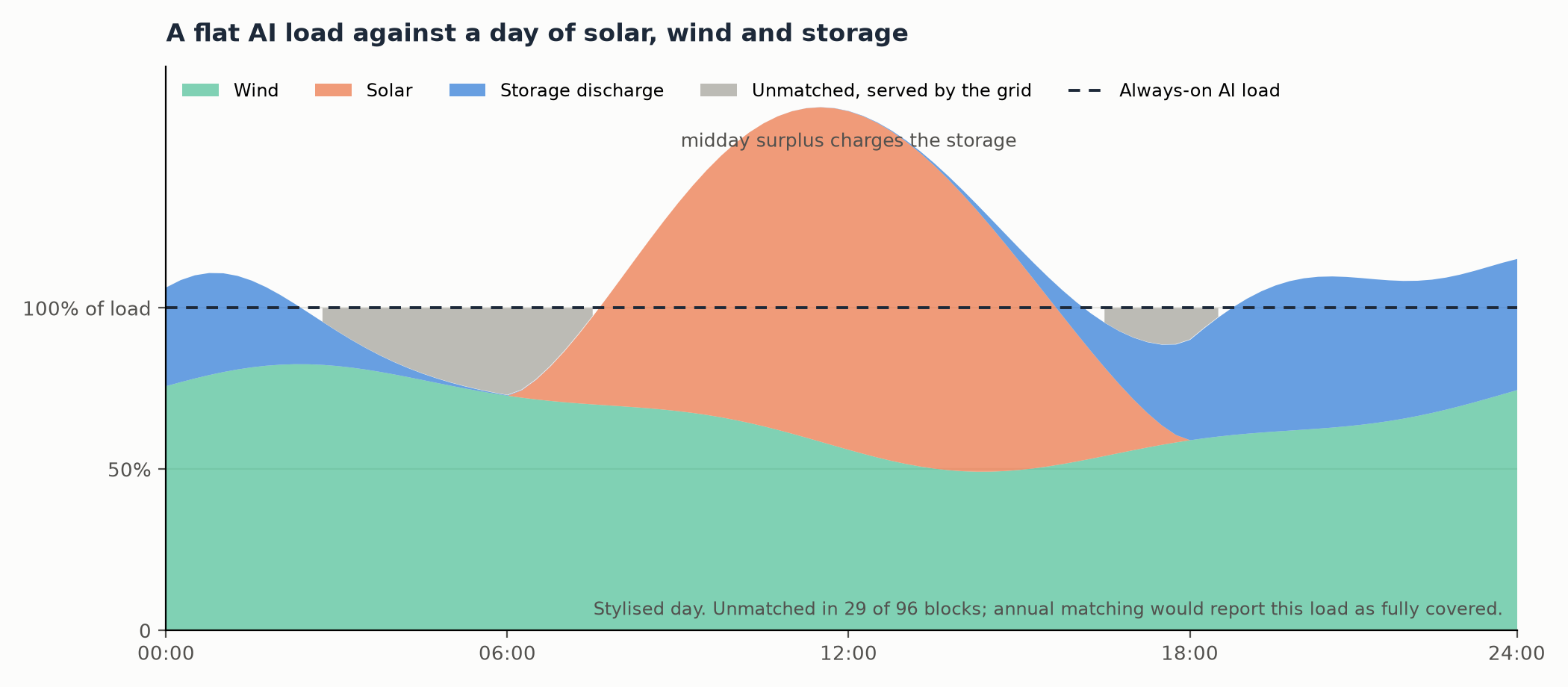
Set the economics aside for a moment and count blocks. A solar portfolio, however large, can deliver into roughly half of the 96 settlement blocks in a day. The other half happen in the dark. No amount of capacity changes that number, because it is a fact about the sun rather than about the contract.
An always-on load consumes in all 96. So a portfolio can be scaled until its annual generation comfortably exceeds annual consumption and still leave every night block served from the grid. The annual figure rises; the unmatched hours do not move. Hourly matching exists because that arithmetic was invisible in the annual one.
What the Last Few Percent Cost#
Two studies have priced hourly matching. Princeton’s ZERO Lab modelled a buyer in California and in PJM with today’s technologies, against a reference of buying from the grid with no clean procurement at all. Annual matching added 3% to costs in California and 10% in PJM. Hourly matching to 98% added 39% and 97%; the last two percent, to 100%, added 64% and 139%. A portfolio with clean firm generation cut those premiums sharply. TU Berlin’s study for Europe reached the same shape: 90 to 95% hourly matching at a small premium over annual matching, with costs rising rapidly above 95%. In Germany, with wind, solar and batteries alone, 98% cost 22% more than annual matching and 100% cost 141% more.
That curve is the design problem. The cheap 90% and the expensive last 10% are decided in the same blocks the figure above shows unmatched, and one lever sits on the load side rather than the supply side: the part of AI work that can wait. Training runs and batch inference can be moved into the hours clean supply exists, which shrinks the unmatched blocks before any storage is bought. How much of a campus can move is a question the companion piece takes up.
What This Means for Anyone Buying Power in the Next Five Years#
The AI buildout is pulling the entire corporate procurement market toward a stricter standard, and the effects will not stay inside the data-centre sector. Once hyperscalers contract for hourly-matched clean supply at scale, they set the reference price and the reference contract structure for everyone else buying from the same generators and the same markets.
For industrial consumers, that means the open-access solar deal that looked cheap on an annual basis will increasingly be quoted and judged on its hourly coverage. For independent power producers, it means a portfolio that can demonstrate block-level firmness commands a premium that a bare solar farm does not. For financiers, it means the underwriting question moves from expected annual generation to the distribution of hourly outcomes across the life of the asset.
All three shifts point at the same missing capability: the ability to simulate generation, storage, network charges, and market prices together, at the resolution the market actually settles, and to do it fast enough to compare portfolios rather than defend a single one. That is the software problem underneath the energy problem, and it is the one EarthSync was built to solve.
Scaling compute has become an exercise in securing power on a date. Claiming that power is clean has become an exercise in matching it block by block. The companies that treat the second as a modelling discipline rather than a procurement formality will be the ones whose numbers survive contact with the meter.