What 15-minute DSM settlement means for C&I consumers
Deviation settlement is the grid's discipline mechanism, and it is moving from monthly averages to 15-minute blocks for open access and captive consumers. Most energy models haven't caught up.
On this page · 7 sections
What Deviation Settlement Actually Is#
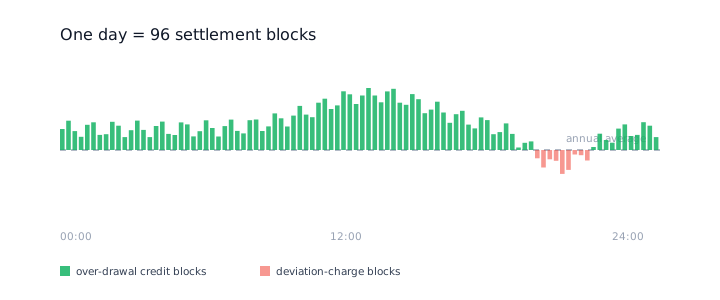
Every entity connected to India's grid at scale (generators, DISCOMs, open access consumers) operates against a schedule: a block-by-block declaration of how much power it will inject or draw, in 96 blocks of 15 minutes per day. The Deviation Settlement Mechanism (DSM) is what happens when reality differs from the declaration. Deviations in each block are measured and priced — over-drawal, under-drawal, over-injection, and under-injection each carry consequences.
The mechanism descends from the Availability Based Tariff era, when unscheduled-interchange charges were linked to grid frequency. The modern CERC DSM regulations have shifted the anchor: deviation charges are now tied to prices discovered on the power exchanges — deviating against the grid at 19:00 costs roughly what power actually costs at 19:00. The design intent is simple: make it cheaper, in general, to trade honestly in the market than to lean on the grid.
From Monthly Netting to 96 Blocks a Day#
For years, C&I consumers with captive or open access renewables lived in a gentler world at the state level. Energy accounting was monthly: units generated anywhere in the month offset units consumed anywhere in the month, and banking provisions let surpluses roll forward. Under that regime, a solar plant was effectively a financial instrument — its generation shape barely mattered, only its annual total.
That world is closing. State regulators are progressively extending 15-minute scheduling and settlement to intra-state open access and captive users, mirroring the discipline inter-state entities have long faced. Under block-wise settlement, a unit generated at 13:00 and a unit consumed at 19:00 are no longer the same unit. Each block settles on its own terms, at that block's applicable rates.
Why Annual-Average Analyses Systematically Mislead#
Consider the standard sales-pitch analysis: a consumer uses 10 million units a year, a proposed solar plant generates 6 million, so solar "meets 60% of demand". At 15-minute resolution, that statement dissolves. On a sunny weekday the plant over-generates through midday — surplus that is banked at a discount, compensated at a low rate, or lapses entirely, depending on the state. On every evening, every night, and every overcast monsoon day, the consumer draws from the grid at full tariff, often in the costliest time-of-day slabs.
The critical point is that the error is systematic, not random. Annual-average analysis systematically overstates the value of a shape-mismatched asset, because it silently assumes every surplus unit is worth every deficit unit. Block-wise settlement prices exactly that assumption — and prices it against the consumer. Two projects with identical annual generation can differ dramatically in delivered value once the settlement rules are applied block by block.
Banking Is Tightening Too#
Banking — the provision that lets a captive or open access consumer deposit surplus renewable energy with the DISCOM and withdraw it later — is the buffer that made annual thinking viable. That buffer is shrinking across states:
- Shorter banking windows: annual banking has widely given way to monthly, and several states have moved to slot-wise banking, where energy banked in one time-of-day slot can only be withdrawn in the same slot
- Banking charges: banked energy is returned after a deduction in kind, commonly around 8–10%, which functions as a haircut on every banked unit
- Caps and lapses: limits on how much of monthly consumption can be met from banked energy, and lapse provisions under which unused banked energy is forfeited or compensated at a low administratively set rate
- Eligibility: some states have restricted banking to captive projects, or narrowed it for third-party open access altogether
The Green Energy Open Access Rules, 2022 pushed back, requiring banking at least on a monthly basis for green open access consumers, but the state-level details, charges, and slot restrictions still decide the economics. The direction of travel is unmistakable: less banking, priced closer to its true cost.
What This Means in Practice#
- Shape beats volume: the right question is no longer "how many units will this plant generate?" but "in which blocks — and what is a unit worth in those blocks?"
- Storage changes role: under block-wise settlement, a battery is not a backup device — it is a settlement instrument that moves energy from low-value blocks to high-value ones and absorbs deviations that would otherwise be penalised
- Wind re-enters the conversation: wind's evening and night generation, long undervalued by annual accounting, is precisely the shape that block-wise settlement rewards
- Forecasting becomes an operating discipline: consumers with open access renewables must submit and revise schedules, and forecast quality flows straight into the deviation bill
Where the Settlement Cost Actually Lands#
Block-wise settlement reads as an accounting change and behaves as a pricing one, because the charge attaches to the price of the block the deviation happened in. Rank June 2026's blocks by price and the top quarter averaged ₹10.00/kWh against ₹1.32 for the bottom quarter. Those top blocks carried 48% of the month's price exposure; the bottom quarter carried 6%.
A megawatt-hour of error is therefore not a fixed liability. Two consumers can miss by the same volume across a month and receive bills an order of magnitude apart, depending only on when they missed. Monthly netting hid that completely. Block settlement does not, and nothing in an annual total tells them apart.
What to Ask Your Analyst#
If you are evaluating a renewable procurement decision (captive, group captive, or open access) these questions separate analysis that will survive the settlement regime from analysis that will not:
- 01Resolution: Is the model built on 15-minute interval data for both load and generation, ideally a full year of each, or on monthly bills and annual capacity factors?
- 02Rules: Does it encode the applicable state's actual banking window, banking charges, ToD slabs, and DSM provisions — as they stand today and as drafted for tomorrow?
- 03Surplus treatment: What happens, block by block, to over-generation? At what rate is it banked, sold, or lapsed?
- 04Regulatory sensitivity: How do the results move if banking tightens further or deviation bands narrow? A robust project survives the next amendment, not just the current rules.
- 05Storage logic: If a battery is included, is it dispatched by an optimiser against block-level prices and rules — or is it a fixed daily cycle bolted onto a spreadsheet?
Fifteen-minute settlement is not a compliance nuisance — it is a repricing of every renewable energy decision a C&I consumer makes. The consumers who model it at its native resolution will procure assets that fit their shape. The ones who don't will discover the gap on their energy bill, one 15-minute block at a time.
Frequently asked questions
- What is the Deviation Settlement Mechanism (DSM) in India?
- DSM is the framework that prices the difference between the electricity an entity schedules and what it actually injects or draws, settled in 15-minute blocks under CERC’s DSM Regulations, 2024, with charges linked to power-exchange prices.
- What changes for C&I consumers under 15-minute settlement?
- Monthly netting disappears: every 15-minute block settles on its own terms, so the timing of generation and consumption, not annual totals, decides the economics of captive and open-access renewables.
- What is energy banking, and why is it tightening?
- Banking lets a consumer deposit surplus renewable energy with the DISCOM and withdraw it later. States are shortening banking windows, applying roughly 8–10% haircuts, and adding caps and lapse rules — which raises the value of storage and accurate scheduling.